

All That She Carried, by Tiya Miles, revolves around a cotton sack from the mid-1800s and its contents. The contents, save one, aren’t even particularly exceptional: a tattered dress, a lock of hair, three handfuls of pecans. And love.
The worn cotton sack was embroidered, in 1921, by the person who it belonged to at that time in order to recount, with a snapshot, her ancestors’ (and consequently her own) story. This is what the embroidery says:
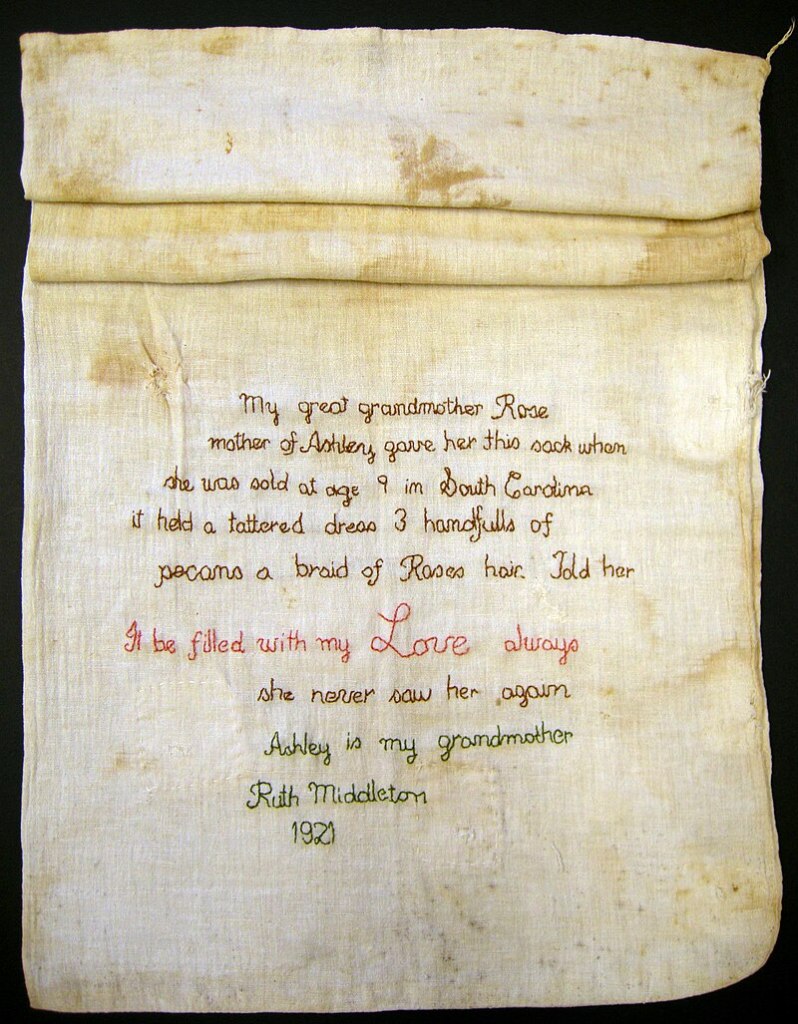
The sack was passed down from generation to generation and in 1921 Ruth, the great granddaughter of Rose, embroidered the sack in order to recount her family’s history of slavery, suffering and survival.
With the death of Ruth’s daughter in the eighties, the story may have never been told, had the sack not resurfaced in 2007 at a flea market in Tennessee.
Standing in front of this object in a museum would certainly be a moving experience. We would fill in the blanks with our own imaginings and musings in order to better understand. We might imagine the setting, the smells, the sounds and wonder what was going through the minds of those directly involved; how afraid and vulnerable they must have felt.
Via anthropological research, reconstruction and analysis, Tiya Miles offers us the opportunity to make the journey with Rose and Ashley (and countless others) from the 1800’s to present day by doing as we would do in front of Ashley’s embroidered sack. She explores parallels and cause and effect. She cross references historical documents, ledgers, inventories, bills of sale and listens to oral accounts from those with a similar family history. She studies migratory patterns, plantation owners, manners, customs and traditions, all with the aim of piecing together this unbelievable history; filling in the gaps through critical thinking and educated assumptions.
A thought process such as this… Think about a mother’s or father’s state of mind as they pack a lunch for their child, on their first day of school. They might prepare the child’s favorite sandwich or slip a surprise note of encouragement in between the foodstuff. They might pack an extra treat to offer some comfort and consolation; to appease anxiety and offer up a moment of pleasure.
Now imagine Rose preparing the sack for her daughter. It is not impossible to comprehend what she was thinking and feeling, nor unrealistic to believe that she must have poured every last drop of love and prayer and hope into that sack, along with the utilitarian items chosen for her little girl.
Rose packed dignity by enclosing a dress (albeit in rags) to offer protection from the elements and to conceal Ashley’s nudity. She gave Ashley sustenance by providing pecans and gave her a strong memory via a lock of her hair. She gave her an everlasting connection, through the sack, to her family; her roots.
This mobile inheritance was to protect and sustain her little girl both physically and emotionally. To ensure she would never feel alone in the world.
The amount of strength required in order to endure such trauma is paramount and quasi unbelievable, yet that is what Rose, Ashley and over 4 million others (in 1860 in America) were forced to do in the name of survival.
The cultural, emotional, historical value of Ashley’s sack is inestimable.
What would we put in our sack and in that of our loved ones were we to find ourselves in that same absurdly cruel and inhumane situation? What would those items tell future generations about our time, place and experience on this Earth?
Discover more from Manu writes
Subscribe to get the latest posts sent to your email.
 Manu writes